No. 011 · · Science
Earth Has a Ring Now. We Built It.
Between nonstop satellite launches (most recently on Sept. 28, when SpaceX put another batch of Starlink satellites into orbit) and steady headlines about tech companies proposing AI data centers in space to run on near-constant sunlight, orbit seems to be in the news every week. All that momentum raised a simple question: how crowded is our sky already?
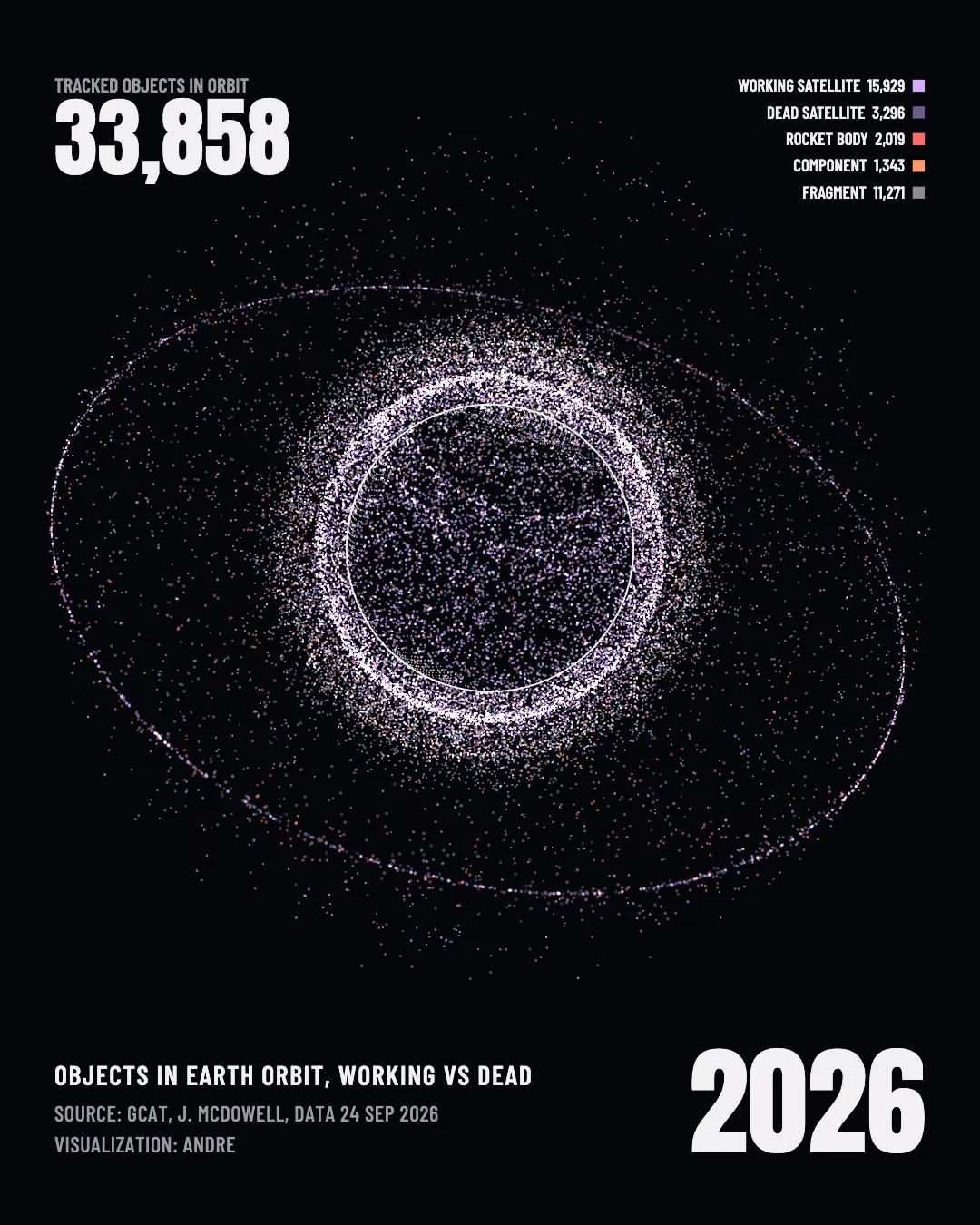
To find out, I pulled the public catalog of every tracked object circling Earth and plotted them all. What came back stopped me: Earth has a ring.
Like Neptune’s, it is faint and easy to miss. Neptune’s rings weren’t confirmed until Voyager 2 flew past in 1989. Ours sits 35,786 kilometers above the equator, where satellites hover over the same spot on the planet. Put every object on the map, and a thin band appears. Unlike Neptune’s, every piece of this one is human-made.
How much is up there
Digging into the catalog kept by astrophysicist Jonathan McDowell at the Harvard–Smithsonian Center for Astrophysics exposes how fast the sky has filled. His catalog follows the same objects the U.S. Space Force tracks.
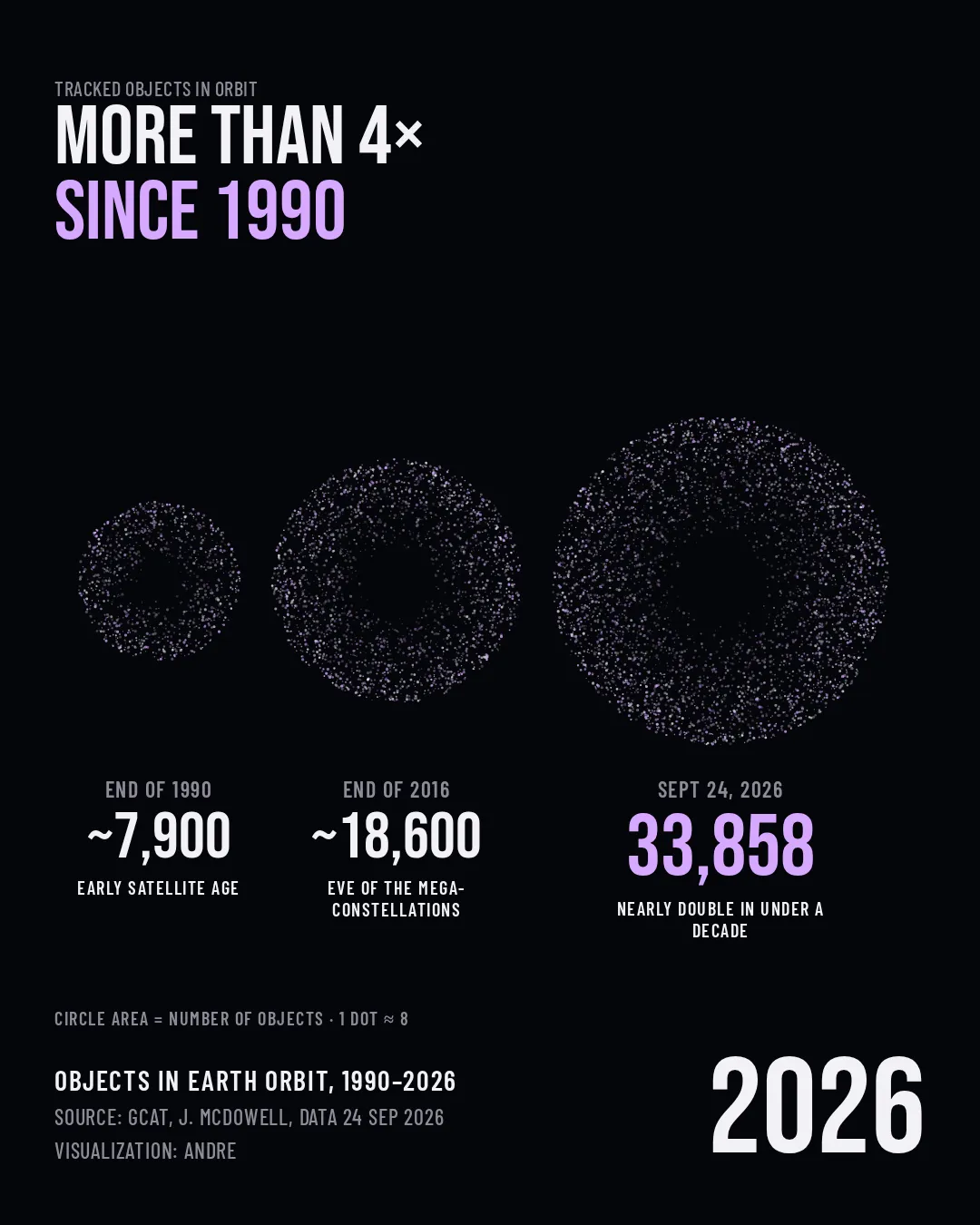
The pace is still rising. The European Space Agency’s 2026 report counts roughly ten new payloads launched every day, more than 4,000 in 2025 alone. And those are only the pieces big enough to track: ESA estimates more than 1.2 million objects larger than a centimeter are up there.
The plans keep getting bigger. In January, SpaceX asked the Federal Communications Commission to launch up to one million satellites as orbital AI data centers, flying between 500 and 2,000 kilometers up. Building just 4% of that would more than double what is in orbit today.
The second surprise
The catalog reveals a second surprise: just over half of those 33,858 objects are dead. About 17,900 are defunct satellites, spent rocket stages and fragments from past explosions or collisions.
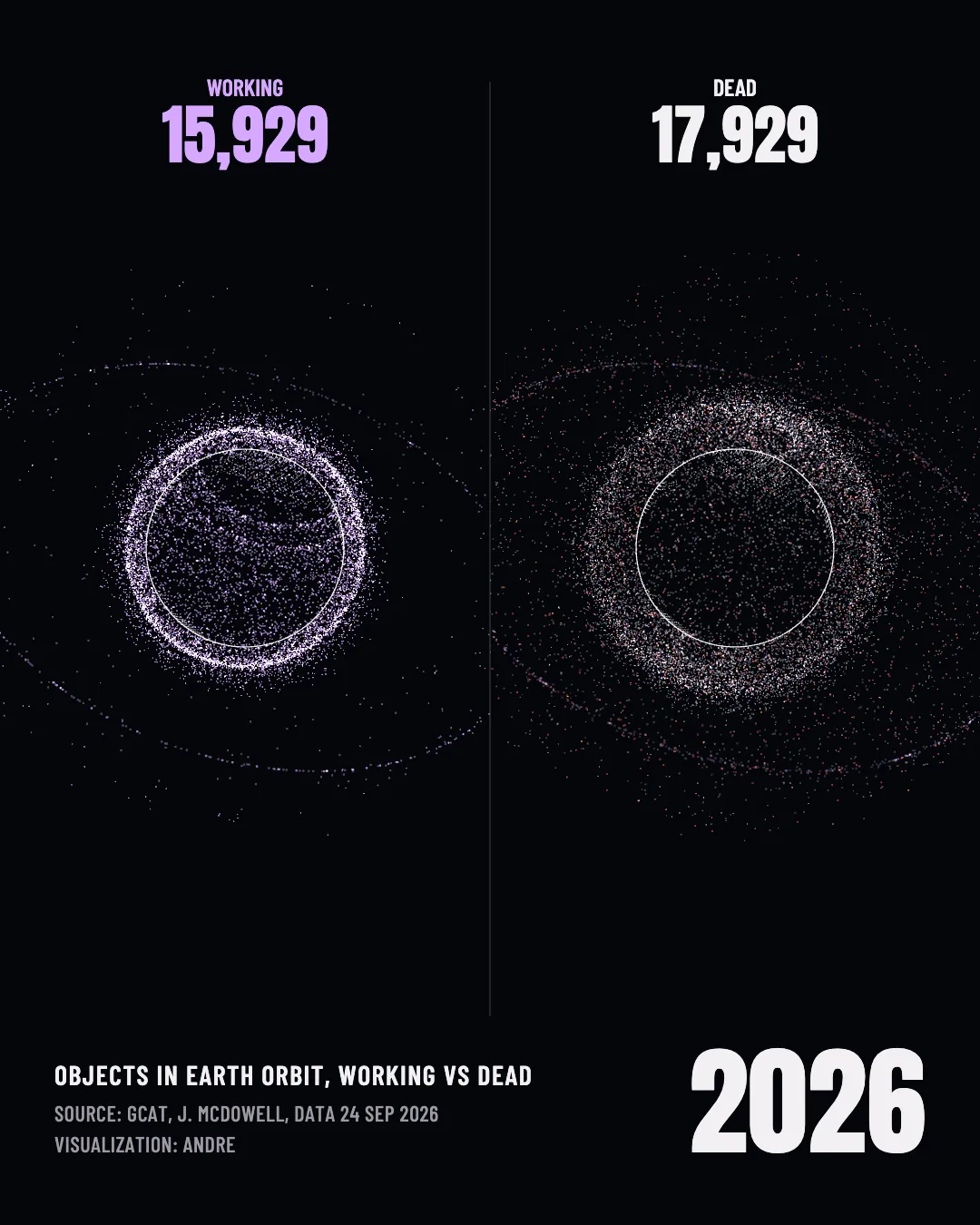
For most of the Space Age, dead objects made up roughly 19 of every 20 things in orbit. That share fell only recently, because working satellites (two-thirds of them Starlink) arrived faster than the junk. The junk itself hasn’t gone anywhere. There is about as much of it now as there was in 2010.
The risk in orbit
NASA’s Orbital Debris Program Office puts the average impact speed at about 10 kilometers per second, fast enough for a centimeter-sized fragment to disable a satellite. The International Space Station fired its thrusters to dodge debris 39 times between 1998 and late 2024. On the ground, the risk stays small: NASA reports no confirmed serious injury from falling debris in more than 50 years.
Why the danger is quieter than the movies show
Remember the scene in WALL-E where a rocket blasts off and plows through a dense shell of space trash? Reality won’t look like that.
Objects in low Earth orbit are typically tens to hundreds of kilometers apart, so you would never see a wall of junk. The real danger is quieter. Scientists call it Kessler syndrome: collisions create fragments that cause more collisions, until some altitudes become too risky to use.
Altitude decides how long a mistake lasts. Below 600 kilometers, dead satellites fall back and burn up within years. At 800 kilometers, they stay up for centuries.
Four ways to fix it
- Make disposal a launch condition: Licenses should require a tested plan to bring a satellite down, not just a promise.
- Pay to remove the worst debris: Large dead rocket stages in long-lived orbits are where a single collision would do the most damage.
- Keep mega-constellations low: Shells below 600 kilometers clean themselves within years; higher ones don’t.
- Track the smaller fragments: Fund the sensors and networks to catalog the million-plus fragments between 1 and 10 centimeters, big enough to disable a satellite but too small for today’s catalog.
Sources
Jonathan C. McDowell, General Catalog of Artificial Space Objects (GCAT), data update Sept. 24, 2026, cross-checked against CelesTrak’s copy of the U.S. Space Force catalog (Sept. 28, 2026); European Space Agency, Space Environment Report 2025 (debris estimates) and Space Environment Report 2026 (launch rate); NASA Orbital Debris Program Office, Frequently Asked Questions; NPR, “ISS dodges debris,” Nov. 20, 2024; Spaceflight Now, CNBC and Light Reading coverage of SpaceX’s Starship launch, Sept. 28, 2026; DatacenterDynamics, “SpaceX files for million satellite orbital AI data center megaconstellation,” Jan. 31, 2026 (FCC application SAT-LOA-20260108-00016); NASA/ESA/CSA Webb Telescope, “Clearest view of Neptune’s rings in decades,” 2022.
To print this page, open its own address and print again.